Sustainable Office Fit-Out in Dubai
The first sustainability decision in an office fit-out is often made before anyone chooses a finish: what will you keep? A serviceable partition, desk or ceiling panel may have a useful place in the new plan. If it is removed before the design team assesses it, the opportunity is lost.

A sustainable office fit-out in Dubai needs a clear scope, evidence behind product claims and an honest account of what the tenant can control. This guide helps you turn those ambitions into a brief and a handover record. It does not promise certification, a particular saving or a healthier outcome for every occupant.
TL;DR
- Assess existing items before strip-out, and record the reason for retaining, repairing or replacing them.
- Ask for evidence linked to the exact material supplied, not a generic “eco-friendly” brochure.
- A certified product and a certified office are different claims.
- LEED has an Interior Design and Construction route that includes Commercial Interiors. USGBC's rating-system guide.
- WELL Certification involves documentation and performance verification. Use the current WELL Program Guidebook and Performance Verification Guidebook for the applicable route.
- Agree who collects the records and who will operate the space after handover.
What should a sustainable office fit-out brief prioritise?
Prioritise the decisions you can check: retained assets, product documentation, operational responsibilities and any formal certification scope. A list of green-looking finishes is not a complete sustainability brief.
Use the following table to turn an intention into a question for the project team. It is a suggested procurement tool, not an official certification checklist.
| Intention | Question to resolve | Record to request | Who should answer? |
|---|---|---|---|
| Retain useful items | What is fit for the proposed use? | Asset list with condition and decision | Designer and responsible technical team |
| Buy documented materials | Does the evidence cover the exact product? | Product reference and relevant declaration or certificate | Supplier and specifier |
| Operate efficiently | What can the tenant actually control? | Equipment schedule, controls and operating instructions | Building management and services team |
| Support indoor environmental quality | Which criteria apply to this scope? | Relevant product evidence and professional review | Specifier and appointed specialist |
| Seek certification | Which rating system, boundary and responsibilities apply? | Agreed certification scope and evidence schedule | Appointed certification adviser |
Choose the priorities before issuing tenders. If one bidder prices retained furniture and another assumes everything is new, their totals are not directly comparable. The same problem arises when a certification adviser is included in one proposal but excluded from the others.
The office renovation service is the starting point for discussing the physical work. Any specialist assessments or certification appointments should be listed separately and confirmed in the actual proposal.
How do you assess reuse before demolition?
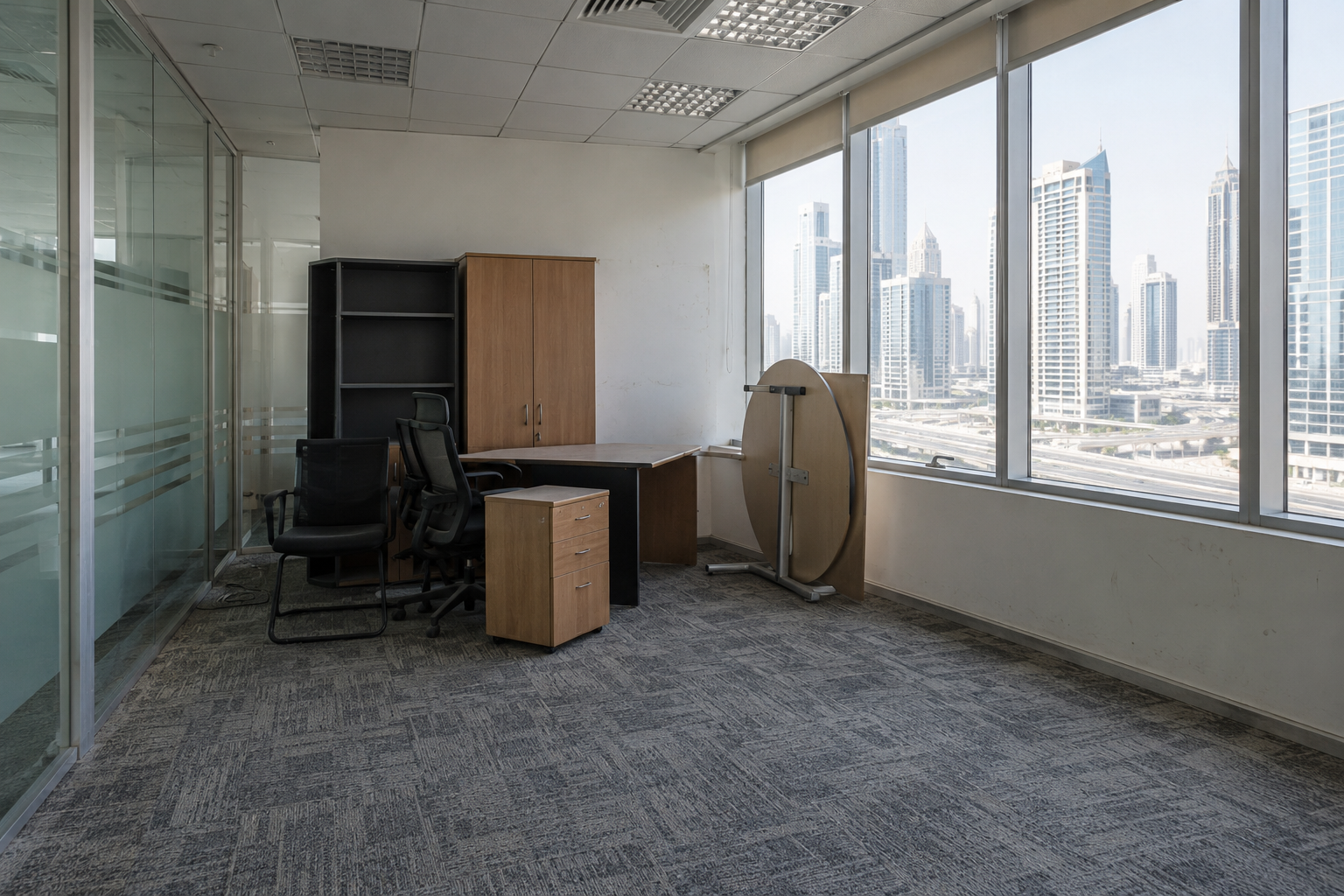
Make a room-by-room asset register before approving strip-out. Record what exists, its condition and where it might fit in the revised layout. Retention should be a reviewed decision, not an assumption that every old item is suitable.
Include furniture, doors, partition components, joinery and visible finish systems. Ask the appropriate professionals to assess building-service equipment rather than judging it by appearance. A working light or air-conditioning outlet does not establish that it is suitable for a different arrangement.
For each item, agree a decision: keep in place, relocate, repair, offer for reuse elsewhere, or remove through an appropriate route. Note dependencies. A retained desk might need a compatible cable arrangement; a partition might need inspection before it can be reused.
Photographs help identify individual items and prevent misunderstandings during mobilisation. Mark retained elements on the drawings and include protection responsibilities in the work package. Do not rely on a verbal instruction to “save the good furniture”.
Where disposal is unavoidable, ask the contractor how different waste streams will be handled and what records can be supplied. Do not report a diversion percentage unless the underlying quantities, method and destinations have been checked.

What evidence should accompany material claims?
Request documentation that matches the product, manufacturer and intended use. Different records answer different questions, so avoid treating a sourcing label, emissions certificate and environmental declaration as interchangeable.
FSC's chain-of-custody guidance explains how forest-based materials are tracked through production and distribution. That is relevant to a responsible sourcing claim. It does not, by itself, establish an office's overall environmental performance.
For low-emission claims, UL Solutions explains GREENGUARD as a product certification based on chemical-emissions testing. UL also distinguishes low VOC content from low emissions and provides a product database for checking certified products. Ask whether the actual product and variant are covered rather than accepting a logo on a supplier's general presentation.
USGBC's environmental product declaration guidance distinguishes product-specific and industry-wide declarations within the relevant credit. If an EPD is proposed, ask your adviser how it applies to the chosen rating-system version and product. Do not infer that any document with “environmental” in its title proves one product is better than another.
A useful material register includes the product reference, intended location, relevant evidence, person responsible for reviewing it and acceptance status. Keep rejected or superseded references clearly separated from approved items. This avoids a common paperwork problem: the certificate is correct, but it describes a product that was not installed.
How can you avoid unsupported sustainability comparisons?
Compare products using the same function and an agreed basis. A broad claim such as “lower carbon” is incomplete unless the comparison, product scope and supporting method are clear.
Ask what is being compared. Is it the same quantity of material, the same installed function or an assumed service life? Are transport, installation and replacement included? The project adviser should explain which comparisons are reasonable for your decisions.
Do not turn a short delivery journey into a complete environmental claim. A locally stocked product may be useful for procurement, but its location alone does not describe how it was made or how long it will perform. Similarly, a reused item still needs to suit the intended use.
Keep the explanation attached to the selection record. If your business later publishes an ESG statement about the fit-out, the person writing it should be able to trace the claim back to the actual project evidence. Marketing language should not become more ambitious than the documents support.
What belongs to the tenant, and what belongs to the building?
Map responsibilities before promising an operational outcome. The tenant may control furniture, lighting selections and working patterns while building management controls other systems or their permitted alterations.
Ask for the available building information, fit-out rules and relevant operating arrangements. Establish who approves changes, who supplies technical information and who will investigate an operational issue after occupation. Record any aspect that is outside the tenant's control.
The office approval guide helps frame the permissions discussion. The responsible team must confirm what applies to the actual property and works; a sustainability objective does not remove the need for applicable approvals.
Do not promise a utility saving from a proposed product alone. Before-and-after comparisons need a stated basis, including what was measured and any relevant changes in occupancy, operating hours or scope. If useful baseline data is unavailable, say so and agree what can be monitored going forward.
How are LEED and WELL different for an office project?
Treat them as distinct certification programmes, with their own scope, criteria and verification. Neither is automatically awarded because an office contains plants, efficient fittings or a certified material.
USGBC lists LEED ID+C Commercial Interiors for interior spaces other than retail or hospitality. Its commercial certification guide describes registration, application, technical review by GBCI and certification. The appropriate rating system and version should be established by the appointed adviser for the project.
IWBI's WELL Program Guidebook sets out documentation requirements for clients enrolled from Q2 2022 onwards. Its WELL v2 testing guidance explains on-site performance testing. That distinction matters when appointing the team: design intent and product paperwork alone are not the entire verification process.
Ask whether you are pursuing formal certification, using selected criteria as briefing references, or simply documenting practical improvements. State the answer clearly in the contract and public communications. “Designed with sustainability objectives” must not be presented as “certified” unless the award has actually been obtained.
This article does not claim that 800 Master Renovations holds LEED or WELL credentials or has delivered certified projects. Any such credentials, specialists or project references must be verified separately before appointment.
How do you organise the evidence without slowing procurement?
Collect documents as products are considered, rather than waiting until handover. Give each requirement a named owner and an acceptance point so procurement knows when a choice can proceed.
- Define the scope. Agree retained items, new work and any certification ambition.
- Issue the evidence requirements. Tell bidders which records their proposed products need.
- Review proposed selections. Check exact references with the responsible specifier or adviser.
- Control substitutions. Recheck evidence when the product or manufacturer changes.
- Record supply and installation. Connect approved references to delivery and handover information.
- Close the gaps. Identify missing records before making a public performance claim.
Use the office renovation checklist for the broader operational brief. Evidence collection is one workstream alongside IT, furniture, access, occupation and site coordination.
What should be included in the cost and handover discussion?
Ask for a work package breakdown, including assessment, protection, refurbishment, procurement and specialist services where relevant. There is no useful universal “green fit-out premium” without defining the work and comparison.
The office fit-out cost guide explains why the starting condition and exclusions matter. Compare the same scope before deciding that one proposal is more economical or more sustainable.
At handover, request the agreed retained-asset record, final product schedule, maintenance instructions, relevant test and commissioning records, and outstanding actions. Establish who can answer questions once employees occupy the office. An organised folder is useful only if its documents correspond to the installed work.
Consider the next change too. Ask how a desk, partition or finish can be repaired or replaced, and which spare components are available. Those are practical purchasing questions, not a prediction of a product's environmental benefit.
Frequently asked questions
Is a sustainable office fit-out always LEED certified?
No. A project can pursue practical sustainability objectives without formal certification. If LEED certification is intended, establish the applicable route and review process with the appointed adviser, following USGBC's guidance.
Does a GREENGUARD product certify the whole office?
No. GREENGUARD is a product chemical-emissions certification described by UL Solutions. Whole-project claims require their own evidence and, where applicable, the relevant certification process.
Should we retain every existing item?
No. Retention depends on condition, suitability and the proposed use. Ask the responsible professional to assess technical items and record the reason for the decision.
Can we pursue sustainability while the office remains occupied?
Discuss the work, protection, access and business requirements with the project team. Some scopes may need separate working areas or temporary relocation. Agree the actual plan instead of assuming sustainability measures will be disruption-free.
Can a contractor guarantee WELL certification?
The contract should not treat the contractor's promise as a certification award. Review IWBI's Programme Guidebook and performance verification guidance. Confirm responsibilities, specialist appointments and conditions before relying on a target.
What should we send for an initial fit-out discussion?
Share the office location, available plan, photographs, occupation arrangements and items you hope to retain. State whether formal certification is a requirement or an option being explored. Include any landlord instructions or existing sustainability reporting requirements.
What should you decide before issuing the brief?
Decide what you want to improve, what the project team can control and what evidence will prove the result. Protect suitable existing assets while the assessment takes place, and keep certification language precise.
You can send an office scope enquiry to discuss the renovation work and the specialist input your project may require. Confirm appointments, responsibilities and exclusions in writing.
Published by 800 Master Renovations. Sources checked 4 October 2026. This is a procurement and project-briefing guide, not a certification assessment or engineering design.